Part of The Saltmere Reach: see the world map
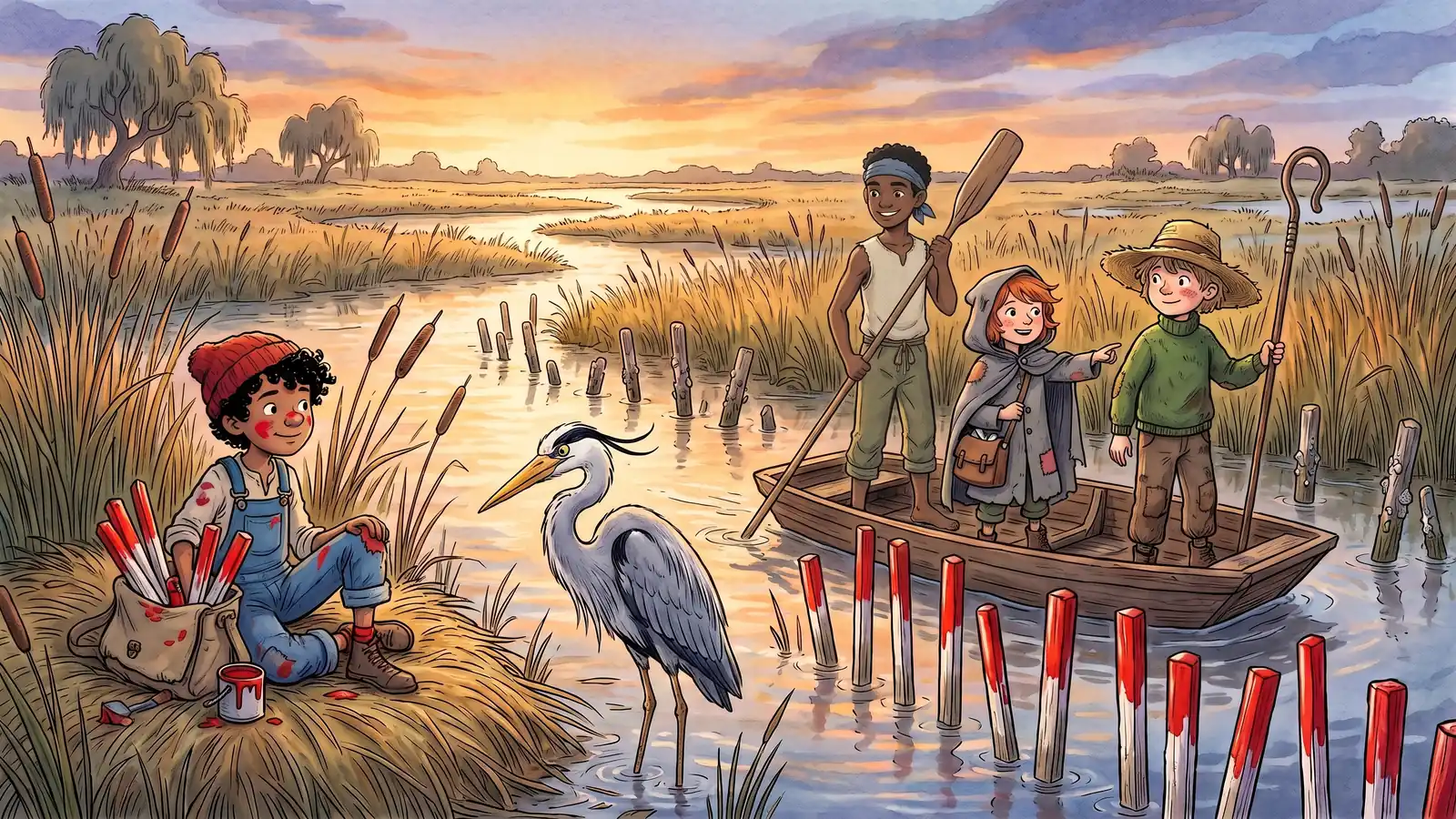
The Stakes That Wandered
Brindle Quay’s chart of the Whistling Fen no longer matches the painted stakes you can see from the Boardwalk. Somebody has been moving them at night. Find out who, and which of the two maps is telling the truth.
Ages 6–12 · gentle, and the library’s first adventure in the Saltmere Reach. Nobody here is wicked: a proud ferry-boss whose chart is a tide behind, an apprentice who has been planting the true channel at night, and a fen that whistles whenever the wind combs the reeds — the whole adventure is solved by walking, comparing, and deciding whom the chart belongs to now.
How long do you have?
Who’s playing?
Tap a hero for each child. Their Heart Points come with you into the game.
For the guide: who you meet, rewards and tips
The map
Who’s in this adventure
Still, the Fen Heron
- Heart Points
- 3
- Guard
- 10
- Attack
- None. Still stands. Still has never once hurt anybody.
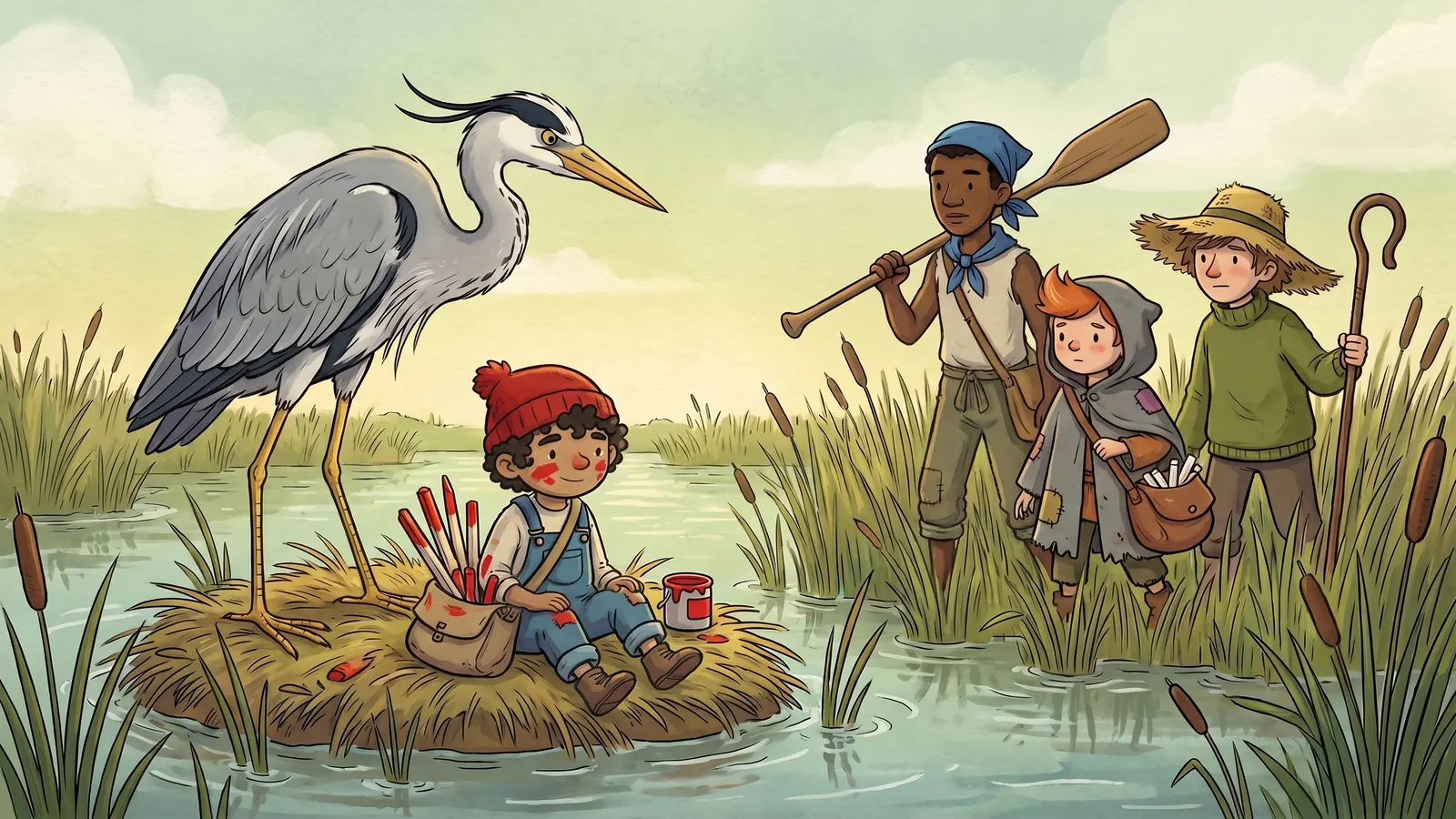
A witness, not a threat. Stands in the shallows like a grumpy wizard and watches whoever is moving stakes. A quiet approach (Kind, Difficulty Number 10) lets you stand beside it. It will not follow you, and it will not leave.
Reed-Vole
- Heart Points
- 1
- Guard
- 12
- Attack
- None. A tug on a paint-rag, and a very determined dive (0 Heart Points).
Hand-sized, and helplessly fond of anything cloth. Put a rag down two steps away and the vole goes after it instead of Nim’s satchel.
Channel-Eel
- Heart Points
- 2
- Guard
- 11
- Attack
- None. A cold slip past the ankle, and gone (0 Heart Points).
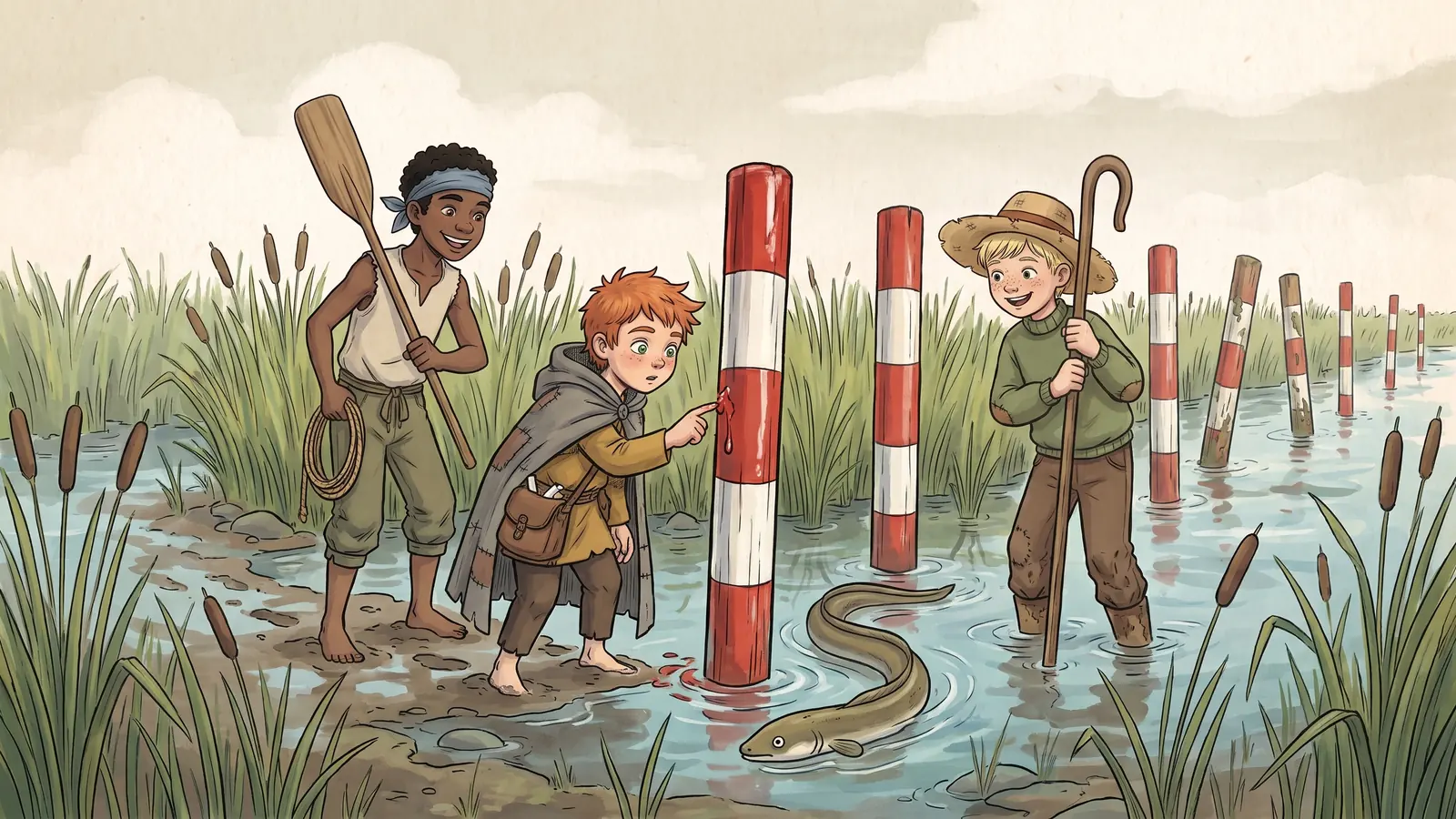
Lives between the stakes. If a hero reaches into the water after a dropped scrap of chart, the eel brings it back: muddy, but back.
Rewards
- A painted practice stake, red band and white band, that each hero may keep and plant in any puddle they like.
- If Brindle drew the new chart herself: a free ride on any ferry in the Reach, for as long as she is ferry boss.
- If the ferry folk voted: Nim’s spare paint-pot, and the only brush in the fen that always matches the official red.
- The fen’s whistle. Once you have walked both lines, you can hear which channel is deep, even with your eyes shut.
Tips for running this one
- Nothing in this adventure fights, and that is on purpose. If a child reaches for a sword, do not stop them: simply have nobody on the other side reach back, and let the scene stay a walk and a talk.
- Make the two lines of stakes things the children can hold. Put a chart on the table. Let them point. The scene goes flat the moment the GM explains what the two lines add up to.
- The question is never "who is the baddie", because there is none. It is "which map do we trust, and who gets to draw it again?" Ask it in those words if the table gets stuck at the hut.
- Short on time? The Quick Quest is Brindle’s hut and the Chart Hut ending, and it still has the twist: Nim walks in and tells it. See the climax’s DM notes.
- Playing with 5- and 6-year-olds? Take 3 off every DN and skip the roll for anything kind. For 9- and 10-year-olds, add 2.
Play together, online
Run “The Stakes That Wandered” online with friends
Can’t get everyone around the same table? Run it at a live online table instead. You direct the game from your screen; your players open a link on theirs and see the same scene art, the same “you are here” map pin, the same dice, their own character sheets, and a party chat. Free, in the browser, nothing to install.
The whole adventure is already loaded there, scene by scene, so you just step the party through it.
No sign-in, nothing saved. Share the link so the family can roll together.
Nobody needs an account: you start a table on this device in one step, and your players join with the code or invite link you send them.
The adventure, scene by scene
-
Scene 1
The Chart That Does Not Match
Read this aloud
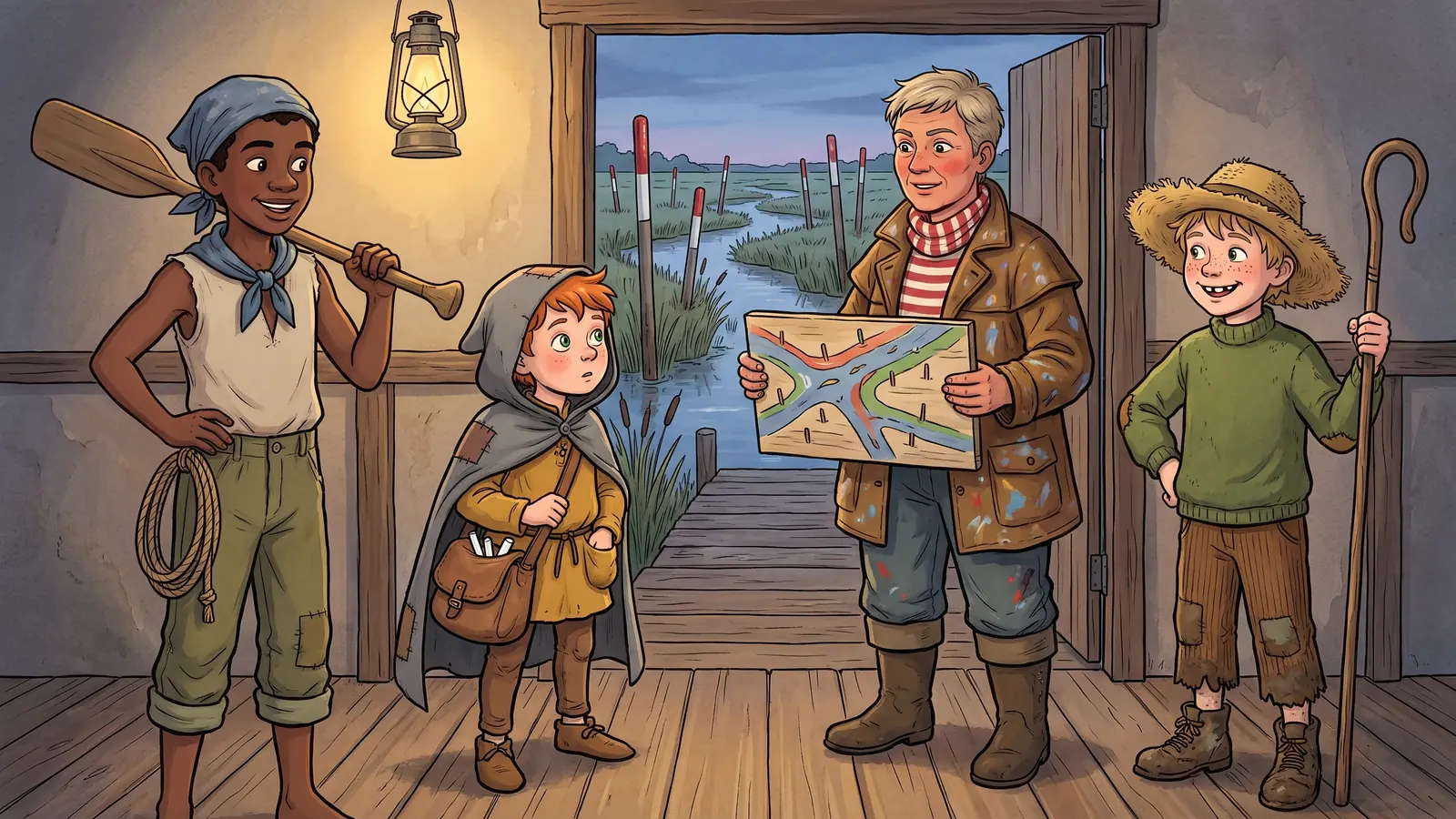
Whee-oo. The reeds whistle when the wind blows through them. This is the Whistling Fen, all water and reeds and wobbly wooden walkways. In her hut, Brindle Quay the ferry boss spreads out her chart. It is a map of every safe channel for boats. Red-and-white posts called stakes mark the way. "Three boats got stuck this week," she says. "Somebody is moving my stakes at night!" From the door, you can see the nearest stake. It is not where the chart says.
What do the heroes try?
- Hero’s bonus
Rolled your own die?
Made it!
Most of the chart is old, neat ink. But there are three new little crosses: the three stuck boats. Every one of them got stuck on the chart’s own channel.
Nearly!
The chart is a jumble of lines. Brindle taps the three new crosses for you: three stuck boats, all on her own channel.
-
No roll needed
Brindle sighs. "Only my ferry folk, same as always. And my helper, Nim. Nim has been coming home late with paint on both hands."
Nearly!
If nobody asks, Brindle mutters it anyway: her helper Nim keeps coming home late, covered in paint.
-
No roll needed
You walk out along the boards. The stake is bright and new. The chart says it should be ten steps to the right. Two maps, one fen.
Nearly!
The walkway wobbles and you slip into the shallows. Splash! But you are standing right next to the stake, and it is not where the chart says.
Notes for the guide
What the heroes want: Find out that the chart and the stakes you can see are two different maps.
Brindle is not the baddie and must never sound like one. She is proud of a chart she drew, and frightened that somebody is making it wrong. The one fact for the table to carry out of this scene: the stakes they can see do not match the chart on the wall. Short on time? At the Quick Quest length, go straight to the Chart Hut: Nim walks in and tells the whole story there.
Questions to ask
- Ask the table: Can everybody whistle like the reeds? Now make the wind blow harder!
- Ask the quietest player: Brindle says somebody is moving her stakes. Who do you think it is? Whatever they guess, nod. There is no baddie in this fen, and the table finds that out together.
Where they are on the map
-
-
Scene 2
Fresh Paint
Read this aloud
The first stake you reach is bright red and white. Touch it, and the paint is still sticky! There is fresh mud round the bottom. Small footprints go off into the reeds. This new line of stakes turns left, just where the chart says go straight. The wind blows, and the reeds whistle. Then you notice something. Where the new stakes point, the whistle is high and happy. Where the chart points, it is low and grumpy.
What do the heroes try?
- Hero’s bonus
Rolled your own die?
Made it!
It is Brindle’s own red and white, from the pot in her own hut. Whoever planted this stake works for the ferry.
Nearly!
You get red paint all over your fingers. Brindle would know that red anywhere. It came from her own hut.
- Hero’s bonus
Rolled your own die?
Made it!
The small, careful footprints stop at every stake. Somebody was planting stakes here, not pulling them up. This is hard work, not a trick.
Nearly!
The reeds are tall and the mud is deep. You lose the footprints, but you saw enough: they stop at every stake, like somebody planting.
-
No roll needed
Reeds whistle high over deep water and low over shallow water. The new line runs where the whistle is high. The chart’s way sounds low and shallow.
Nearly!
Everybody is talking too much to hear. Hush, and listen again: high over deep water, low over shallow.
Notes for the guide
What the heroes want: Find out that a new line of stakes was planted last night, carefully, by somebody working hard.
Make the new line feel like hard work, not a trick. If a child pulls a stake up, let them: it comes out easily, and putting it back is clearly the right thing. Do not say yet who planted it. Old Cress can pole past in her boat without stopping; save her for the next scene.
Questions to ask
- Ask the table: Can everyone make a high, happy whistle? Now a low, grumpy one?
- Ask each player in turn: If you could paint your very own stake, what colours would it be?
Where they are on the map
-
-
Scene 3
The Chart’s Own Stakes
Read this aloud
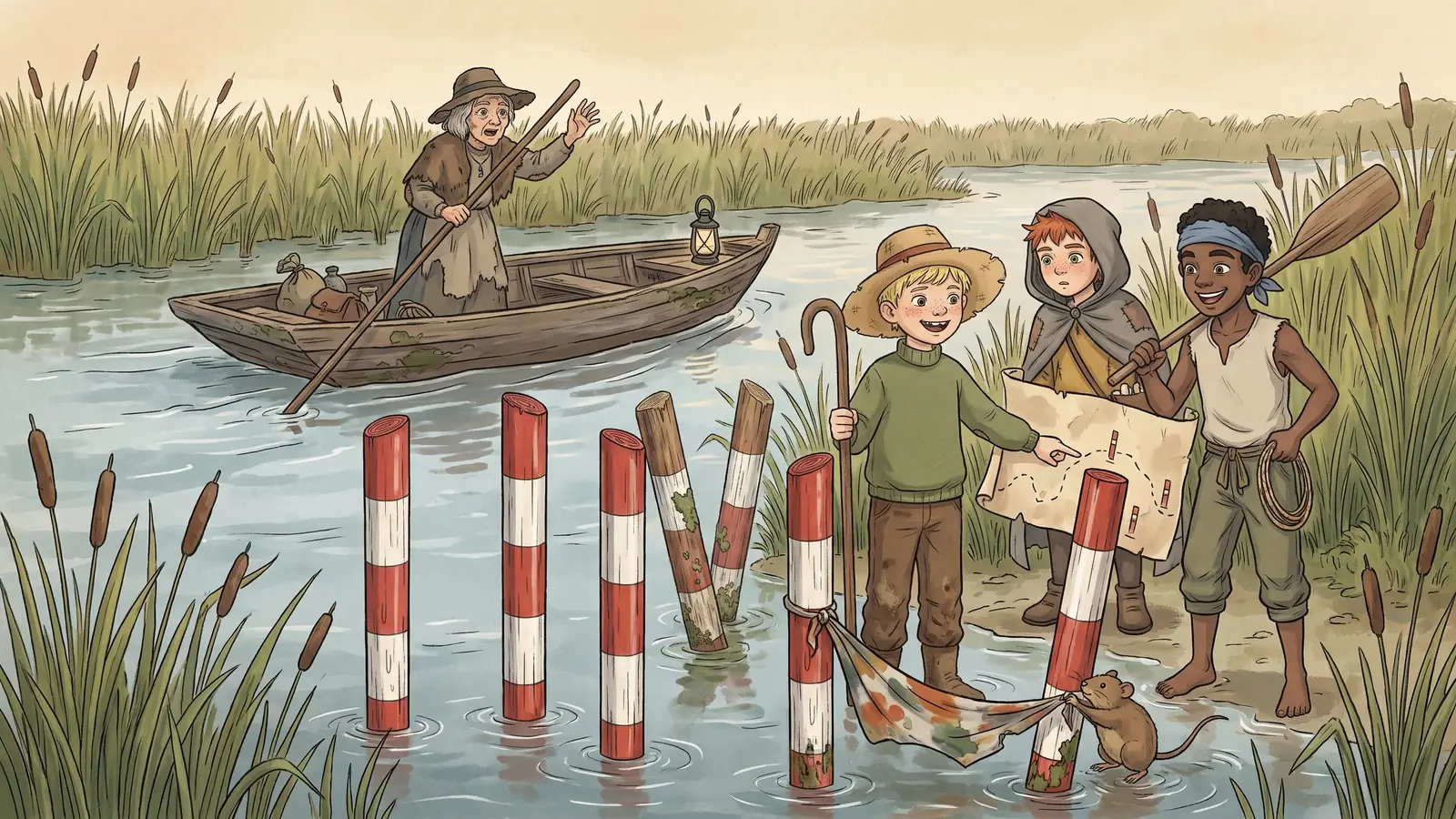
Further in, you find a second line of stakes. They are the same red and white, but faded and leaning. And every one stands exactly where the chart says. Two lines of stakes. One fen. Which one is telling the truth? An old woman poles a flat boat past, slow as a duck. "There used to be two lines," calls Old Cress. "One for high water, one for low. We stopped painting the second one years ago."
What do the heroes try?
- Hero’s bonus
Rolled your own die?
Made it!
It matches perfectly, stake by stake. Brindle drew her chart from this old line, a long time ago.
Nearly!
The chart flaps in the wind. Old Cress holds one corner for you. It matches the old line, stake by stake.
- Hero’s bonus
Rolled your own die?
Made it!
The faded stakes lead off into the reeds, leaning and peeling. The water gets shallower at every stake. Off you go to see where they end.
Nearly!
You go the long way round through the reeds, with very wet socks. But you find the faded stakes again, and follow them on.
- Hero’s bonus
Rolled your own die?
Made it!
Old Cress stops. "Brindle’s chart was perfect, the year she drew it," she says. "But a fen never sits still for a map."
Nearly!
Old Cress does not hear you at first. Then she turns round, smiling. "A fen never sits still for a map, you know."
Notes for the guide
What the heroes want: Hold both maps at once, the faded old line and the bright new one, and choose which to follow.
The heart of the mystery. There is no missing water and no dam here: there are two maps of the same water, and only one of them is still true. Any two of the three ways through are enough to head for the barge. Nobody in the fen gets cross if accused. They just go quiet.
Questions to ask
- Ask the quietest player: Here is a scrap of Brindle’s chart, with notes on the back. Will you read the notes out? Hand over The Chart and the Tide-Table now.
- Ask the table: Two lines of stakes, and they disagree. Which one would you follow, and why?
Where they are on the map
Show your players this
The Chart and the Tide-Table
A scrap of Brindle’s chart, with a tide-table pinned to the corner. The day of the big spring tide has two circles round it. On the back, in small, newer writing: "RED means deep water. WHITE means turn here. Do not follow the faded ones. THE BARGE MOVED." At the bottom, half crossed out: "I will tell her when she is ready to listen."
Print this handout -
-
A side path
Along the Faded Stakes
Read this aloud
You follow the faded stakes deeper into the reeds. The water gets shallower with every step. Here the reeds whistle low and grumpy. On top of one leaning stake sits a reed-vole. It is no bigger than your hand. It has made a cosy nest from an old paint-rag. The vole glares at you. This is its stake now! Far ahead, somebody is singing. It sounds like a stuck boat having a picnic.
What do the heroes try?
- Hero’s bonus
Rolled your own die?
Made it!
You hold out a hanky. The vole grabs it, stuffs it into its nest and squeaks a tiny thank you. Then it sits up and points its nose toward the singing.
Nearly!
Plop! The vole dives into the water. It pops up on the next stake along, still very cross. That stake leans toward the singing too.
- Hero’s bonus
Rolled your own die?
Made it!
The stick hits mud almost at once. This old line was a good way once, but a boat would get stuck here now. The low whistle was right.
Nearly!
The stick sticks in the mud with a big slurp. You pull it out, all gloopy. Too shallow for a boat, that is for sure.
- Hero’s bonus
Rolled your own die?
Made it!
You splash on, stake after stake, and round the last bend. There it is: a big dark shape in the water, with a little ferry sitting on top.
Nearly!
A channel-eel slips past your ankle, cold and quick. Eek! You jump, then laugh, and wade on. Round the bend is a big dark shape in the water.
Notes for the guide
What the heroes want: Walk the old line and find out for yourselves that the water along it is too shallow for boats now.
Play this scene only when the heroes chose to follow the old line at the Chart’s Own Stakes. The story then goes on to Where the Chart Now Goes, as it always does. The one fact to carry out: the old line runs through water that is shallow now, so the low, grumpy whistle was telling the truth. Play the reed-vole as a tiny, very cross landlord. Nobody gets hurt and nothing chases. Nothing later needs this scene: the barge proves the chart is old on its own.
Questions to ask
- Ask each player in turn: The vole made a cosy nest on top of a stake. What would you put in your very own nest?
Where they are on the map
-
-
Scene 4
Where the Chart Now Goes
Read this aloud
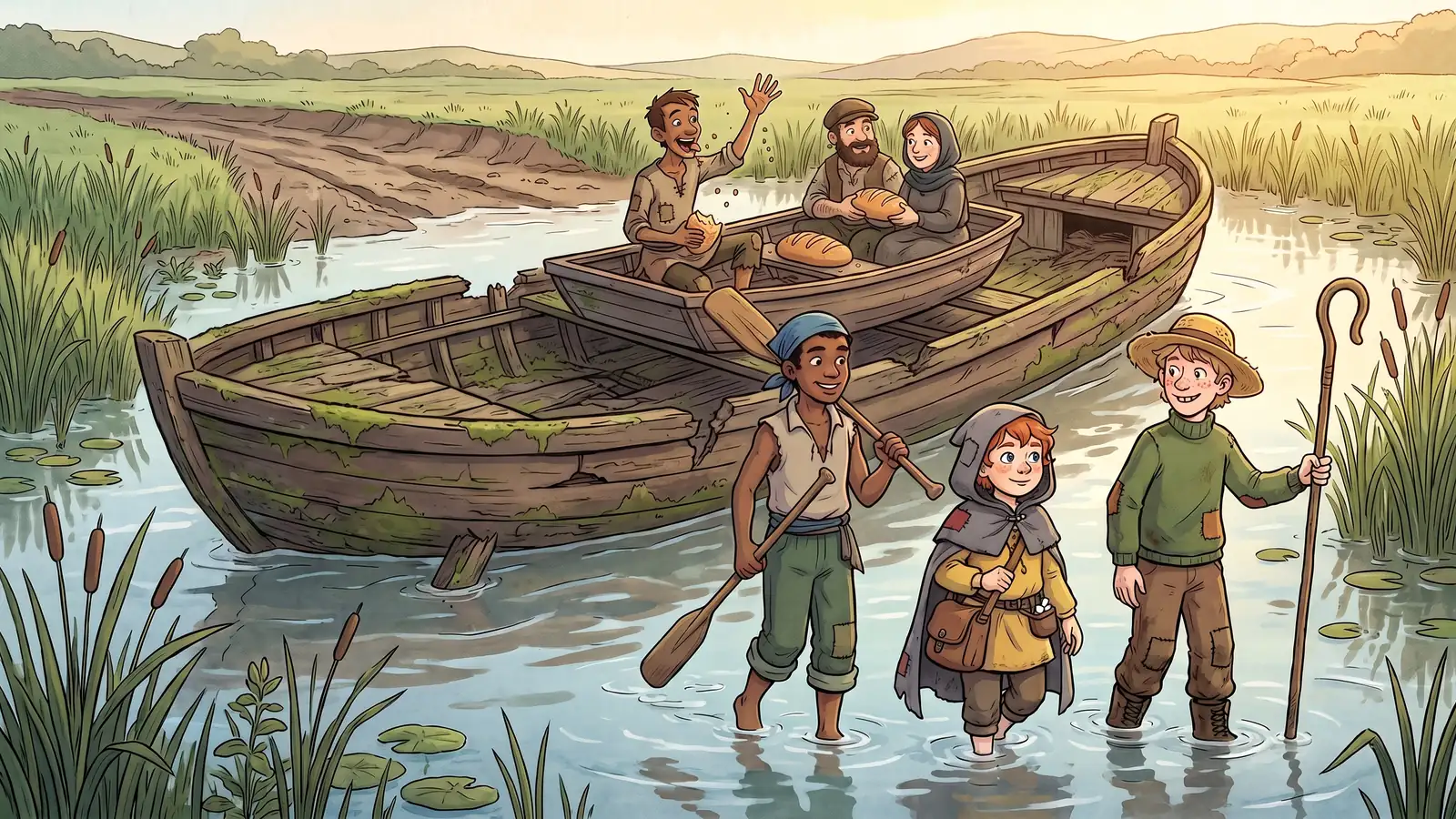
The old line goes right over the Sunken Barge. That is a big, broken boat lying under the water. But it was never here before! There is a long, fresh scrape in the mud. The big spring tide must have pushed it. And sitting on top of it, stuck fast, is Wick’s ferry. Everybody on board is fine. They are sharing bread. "We followed the chart," says Wick cheerfully. "The barge moved. The chart did not."
What do the heroes try?
- Hero’s bonus
Rolled your own die?
Made it!
Heave! The ferry slides off the barge with a big squelch. Wick shakes everybody’s hand. "I am not following that chart again," he says, "until somebody draws it new."
Nearly!
Everybody heaves, and nothing moves. Then the tide comes in a little and lifts the ferry off by itself. Wick laughs and thanks you anyway.
- Hero’s bonus
Rolled your own die?
Made it!
From up here it is easy to see. The barge has slid right across the chart’s channel, so the water there is too shallow now. The new line goes round it.
Nearly!
The barge is slippery with weed, and you sit down with a bump. From there you can still see it: the barge lies right across the chart’s channel.
- Hero’s bonus
Rolled your own die?
Made it!
Across the reeds, somebody with a satchel of stakes and a paint-pot looks up. They do not run. They give a small, shy wave.
Nearly!
Your shout makes a heron flap up. Then a small figure with a paint-pot peeks out of the reeds. They do not run.
Notes for the guide
What the heroes want: See what trusting the old chart costs: a stuck boat, and nobody hurt.
No chase, no sinking, nobody hurt. The barge is the proof: the chart is a tide behind, and the new stakes go round the barge. Take as long as the table wants looking at it.
Questions to ask
- Ask the table: Wick’s crew are having a picnic on a stuck boat. What would you put in your sandwich?
- Ask the quietest player: Wick followed the chart and got stuck. Was that his fault? Let them think. Following the chart was sensible. The chart was just old.
Where they are on the map
-
-
Scene 5
Bonus: The Apprentice at Heron Stand
Read this aloud
At Heron Stand, a tall grey heron stands in the shallows. It looks like a grumpy old wizard. The ferry folk call it Still, because it hardly ever moves. Below it, on a little island of grass, sits Nim Sedge. Nim has a satchel full of new stakes and a pot of red paint. Nim does not run. "I moved them," Nim says. "The old line goes over the barge now. Brindle will not listen. So I plant the true channel at night."
What do the heroes try?
- Hero’s bonus
Rolled your own die?
Made it!
Nim takes a big breath and stands up. "Only if you come too." Nim will tell Brindle the whole story at the hut.
Nearly!
Nim is not ready yet. "Let me finish the line first." But at the hut, Nim comes anyway, a little way behind you.
- Hero’s bonus
Rolled your own die?
Made it!
You sit on the grass and hear all of it. Nim is twelve, and very tired. "Promise you will tell Brindle it was for the boats?" Make the promise, and tick the box on the story tracker.
Nearly!
Nim talks slowly, then stops, then starts again. It takes a while, but you hear everything. Nim asks you to promise to tell Brindle it was for the boats.
-
No roll needed
Squelch, push, done. Three stakes stand in a straight red-and-white line. Still the heron watches and does not blink. The true channel is finished.
Nearly!
One stake goes in crooked. Nim laughs and helps you fix it. The true channel is finished, and Still the heron does not blink.
Notes for the guide
What the heroes want: Hear Nim’s side, and decide how to help.
The quiet wonder scene, and the reason to run the Epic length. Nothing here is needed for the plot: the barge already proved the chart is old. But a table that has sat with Nim argues differently at the hut. Whatever they promise here, remind them of it at the hut. Keeping it is their choice, not a trap.
Questions to ask
- Ask the table: Can everyone stand as still as a heron? Who can stay still the longest?
- Ask the quietest player: Why do you think Nim moved the stakes at night, and not in the daytime? Because it is scary to tell a grown-up they are wrong. Let them say it.
Where they are on the map
-
-
Scene 6
Whose Chart
Read this aloud
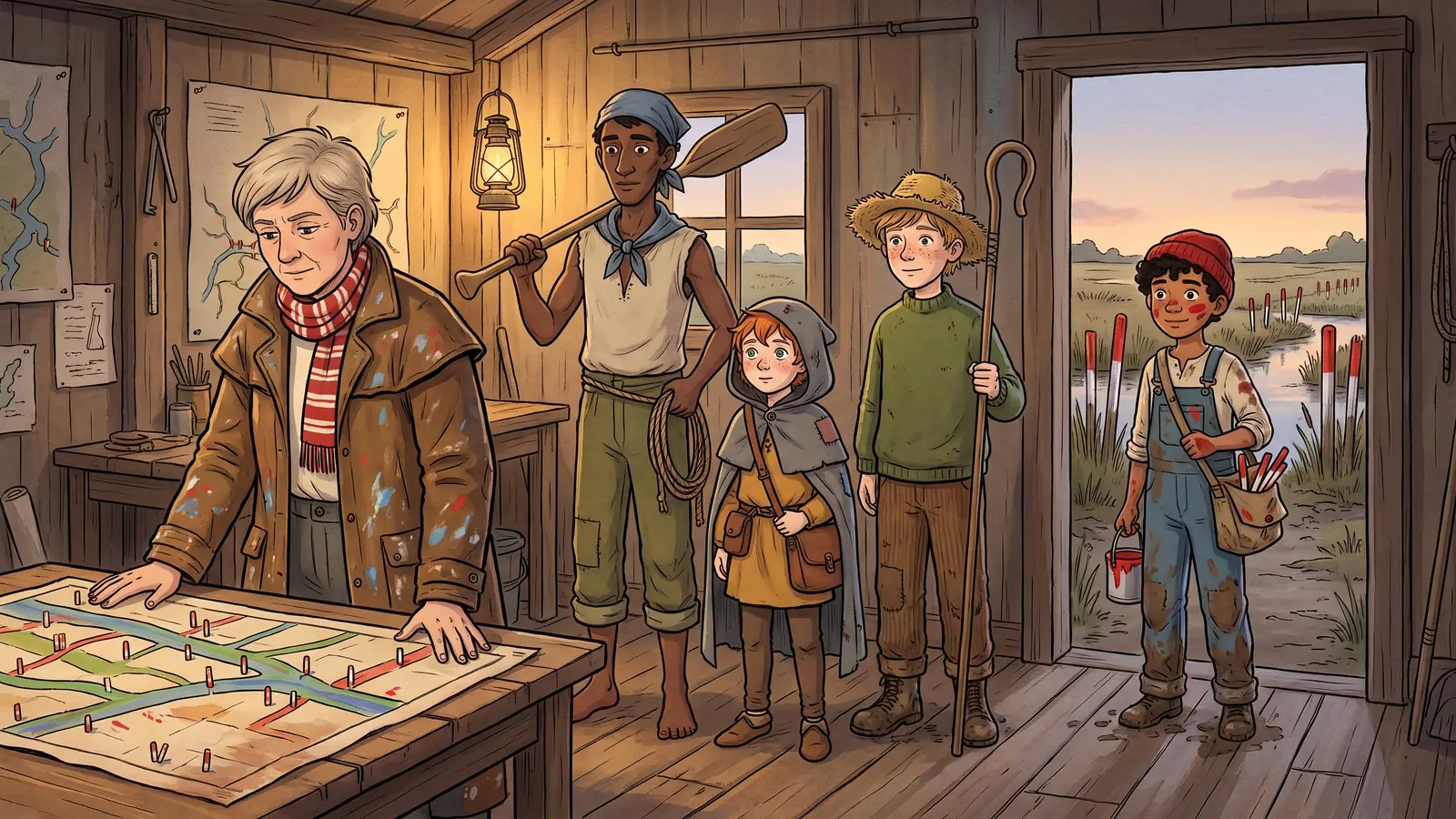
Back in the Chart Hut, Brindle looks at her chart. Then she looks at you. Nim stands in the doorway, muddy to the knees. "I moved the stakes," Nim says. "The big spring tide pushed the old barge. Your chart goes right over it now." Brindle is quiet for a long time. "That is my chart," she says at last. "I drew it so carefully." The reeds whistle outside. Brindle looks at you. "Well? What do we do?"
What do the heroes try?
- Hero’s bonus
Rolled your own die?
Made it!
At low water, Brindle stands by the barge and looks for a long time. Read "If you showed her."
Nearly!
Brindle folds her arms. "Not today." Ask again at the next low tide. She comes, and this time it needs no roll. Read "If you showed her."
- Hero’s bonus
Rolled your own die?
Made it!
At the ferry meeting at sunrise, you stand up and tell everyone about the barge. Read "If the ferry folk voted."
Nearly!
Your voice goes wobbly. Then Wick stands up beside you. "It is true. I was stuck on it." Read "If the ferry folk voted."
-
No roll needed
You pin both maps on the wall. Brindle’s says OLD CHART. Nim’s says TRUE TODAY. Read "If you hung both maps."
Nearly!
Brindle frowns at the second map. Then she finds a pin herself. Read "If you hung both maps."
How it ends
Read the ending that happened, then the homecoming.
If you showed her.
Where your choices led
Brindle crouches by the barge. She touches the fresh scrape in the mud. "Well," she says softly. "The fen moved, and I did not." That evening she draws a brand new chart. At the bottom she writes: "With help from Nim." Then she hands Nim the brush.
If the ferry folk voted.
Where your choices led
Every hand goes up, even Brindle’s, in the end. The ferry folk choose Nim’s line as the new safe channel. Brindle paints the first new stake herself, and Nim paints the second. Everybody cheers. Still the heron flaps off in a huff.
If you hung both maps.
Where your choices led
Both maps hang side by side on the hut wall, old and new. Every ferry child learns to read them both. Brindle and Nim stand in front of them, pointing and chatting. Nobody will ever be fooled by one old map again.
Homecoming
Every ending: the boats come home.
That night, the boats come home along the true channel, lanterns bobbing. Not one gets stuck. Wick waves from his ferry. Brindle gives each of you a little painted stake, red and white. "Plant it in any puddle you like," she says. Outside, the reeds whistle high and happy.
Notes for the guide
What the heroes want: Decide whose map the fen should trust now, and who gets to say so.
Three real endings and no wrong one: never let this become an argument the table loses. Brindle would never raise her voice to a child in her own fen. Walking Brindle to the barge needs no roll if the heroes made Nim a promise and keep it now, or planted the last stakes with Nim (see the story tracker). If the table hangs both maps, play it as a kindness, not a draw. Short on time? At the Quick Quest length, Nim’s words in the doorway are the whole twist: let the heroes ask Nim anything they like, then choose. Read the ending that happened, then the homecoming.
Questions to ask
- Ask the table: Brindle is sad her chart was wrong. What could you say to help her feel better?
- Ask the quietest player: Who should choose where the boats go: Brindle, Nim, or everybody? There is no wrong answer. Each answer is one of the endings.
Where they are on the map
-